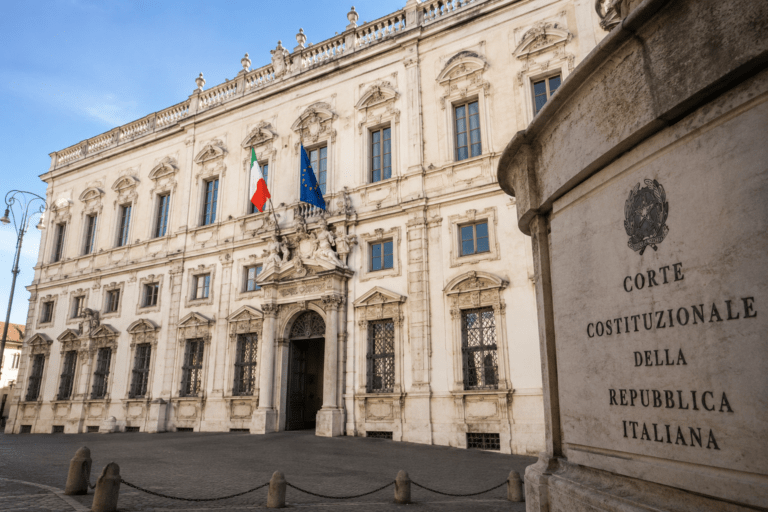

The door left open: Proof of activation after the Tajani Decree

Following Constitutional Court Ruling 63/2026, headlines claimed that the Tajani Decree (Law 74/2025) had permanently closed the door on Italian citizenship by descent (jure sanguinis). However, a careful legal analysis of sections 9.1 and 9.2.2 reveals a critical protection: the door remains open for those who actively initiated their recognition process before the March 27, 2025 statutory deadline, even if they never secured a consular appointment.
In this episode, Avv. Salvatore Aprigliano breaks down the legal doctrine of Proof of Activation and the principle of Legitimate Expectation (legittimo affidamento). Discover how Italian judges distinguish between “inactive” applicants and those who took documented, concrete steps to assert their rights before the law changed.
What you will learn in this episode
- The Active vs. Inactive Distinction: How Sections 9.1 and 9.2.2 of Ruling 63/2026 protect applicants who took action prior to March 27, 2025.
- What Qualifies as Proof of Activation: The exact paper trail Italian judges require, including certified record requests, translations, apostilles, consulate communications, Prenot@mi error screenshots, and signed legal mandates.
- What Evidence Is Too Weak: Why general interest, oral family history, or undated inquiry emails will fail in court.
- The 2026 Court of Bologna Precedents: How Rulings 3335 (April 17, 2026) and 4038 (May 13, 2026) used consular emails and pre-deadline legal retainers to secure citizenship under legacy rules.
- Building an Evidentiary Timeline: How to convert isolated receipts, emails, and document requests into a cohesive, legal argument before an Italian tribunal judge.
00:00:03.800 — 00:00:17.840
After the Constitutional Court’s ruling 63 of 2026, many Italian descendants had the same reaction. They read the headlines, saw the comments online and thought it’s over.
00:00:18.880 — 00:01:33.330
The Constitutional Court saved the Tajani decree, but the story isn’t that simple. Let me be clear. I don’t agree with many parts of the court’s reasoning. In my view The Tajani Decree raises serious compatibility issues with European Union law. I’ve said it before, but even within the Constitutional Court’s reasoning, there’s a door that wasn’t closed.
That door concerns those who had already started the citizenship recognition process before March 27th, 2025, but hadn’t received a consular appointment in section 9.1 of the ruling. The court states this issue remains open in section 9.2.2 of the ruling. It also adds that from the perspective of legitimate expectation, those who had already taken action before that date cannot be treated the same as those who remained inactive.
Simply put. Not all post cases are the same. And this brings us to the central question of this episode. What does it mean to have taken action before March 27th, 2025?
00:02:00.690 — 00:03:44.840
In the language of the Constitutional Court. There is a word that is central today. Inactive and inactive person is someone who, before the Tajani decree had done nothing to obtain recognition of Italian citizenship, hadn’t really started the process, hadn’t turned the idea into concrete action.
But on the other side there is a different category. There are people who, before March 27th, 2025, had already taken action. Maybe they didn’t have an appointment yet, maybe they hadn’t filed an application yet. Maybe they were stuck on the consular portal, but they had already started a real process.
And this distinction is fundamental, because the Constitutional Court itself says that from the perspective of legitimate expectation, you cannot treat those who took action and those who remained inactive in the same way. In simple terms, if you had already taken concrete steps relying on the old rules, your case deserves a different interpretation.
This doesn’t mean it’s an automatic win. It wouldn’t be honest to say that, but it means your case cannot be dismissed with a simple phrase: you didn’t have an appointment, so you’re out. The real question becomes another before March 27th. Were you still in the phase of simple interest, or had you already started a concrete path toward the recognition of Italian citizenship?
This is where the issue of proof of activation arises.
00:03:50.360 — 00:05:44.470
At this point, the question becomes very practical: what can count as activation? The answer is there is no magic formula. Before the Tajani decree, no law said “to protect your right, you must do exactly this.” There was no official list. There was no special form. There was no rule saying only those who already have an appointment are safe.
In reality, a citizenship application starts long before the consular appointment. It starts when you reconstruct the family line, when you look for the birth certificate of the Italian ancestor, when you look for naturalization documents, when you start translations, or the collection of records and certificates, when you contact the consulate, when you hire a lawyer or a genealogist, when you try to log in to the system and find out there are no dates available for appointments — all of this can have value. But watch out.
It’s not enough to just talk about it. You have to prove it. You need dated documents, emails, receipts, screenshots, requests sent to Italian municipalities, communications with consulates, professional mandates. Evidence that proves one simple thing: before March 27th, 2025, you weren’t standing still.
You had already started a real path toward the recognition of Italian citizenship. This is the core of the proof of activation — not just showing that you have Italian origins, but proving that before the change in the law, you had already concretely started trying to assert that right.
00:05:49.350 — 00:07:29.060
Now, though, we need to be very clear. Not everything is proof of active steps. A general interest in Italy isn’t enough. A family story passed down by word of mouth isn’t enough. A simple genealogy search done out of personal curiosity might not be enough. A vague email like “I’d like information on Italian citizenship” might be too weak if it’s not linked to a concrete path.
Because the point isn’t to show that one day you would have liked to become an Italian citizen. The point is to prove that before March 27th, 2025, you had already seriously started that process. The judge needs to see a paper trail, a timeline, a set of consistent actions — something showing you weren’t standing still, that you weren’t just curious, but that you had already taken active steps to obtain recognition of your Italian citizenship.
The quality of the proof is fundamental. Generic proof is weak. Undated proof is weak. Proof that isn’t clearly linked to Italian citizenship is weak. But proof that is dated, consistent, documented and linked to the recognition process can become very important. In other words, it’s not enough to say “I was interested.”
You need to be able to say “I had already concretely started asserting my right, and I can prove it.”
00:07:32.500 — 00:11:34.040
And this is where the decisions of the Court of Bologna become important — not because they automatically guarantee the same result in every case. It doesn’t work that way. Each judge evaluates the individual appeal, the evidence produced, the timeline of events, and the legal arguments presented. But those decisions give us an initial, practical roadmap.
In ruling 3335 of April 17th, 2026, the Court of Bologna gave weight to documented communications with the consulate prior to March 27th, 2025. In ruling 4038 of May 13th, 2026, the court also gave weight to a legal mandate signed before March 27th, 2025. In both cases, the point wasn’t just genealogy.
The point was to prove that the applicants, before the Tajani decree, had already shown in a concrete and documented way their desire to obtain recognition of Italian citizenship. This is a very important step. At the same time, in our view, the concept of “taking action” shouldn’t be interpreted too restrictively.
The Constitutional Court doesn’t say that there are rigid categories of taking action — one stronger and one weaker, one valid and one invalid. The distinction that emerges from the ruling is simpler and more profound. On one side, there are those who remained inactive. On the other, there are those who had taken action, who had already started, before the law changed, a concrete path toward the recognition of Italian citizenship. That’s why the Bologna decisions are a very useful sign. But they shouldn’t be read as the only possible way. In our view, there can be different forms of taking action, as long as they are serious, documented, dated and linked to the recognition process.
So the question isn’t just “what kind of document do you have?” The real question is: can you prove that before March 27th, 2025, you hadn’t just stood by? So what should you do now? You should reconstruct your timeline — not just your family tree. Your timeline. Go back to everything that happened before March 27th, 2025. Did you contact the consulate? Did you try to book an appointment? Did you take screenshots of Prenot@mi showing the lack of available dates? Did you request birth, marriage or naturalization certificates? Did you start translations? Apostilles? Corrections of records? Did you pay a genealogist, a lawyer, a translator, or another professional? Did you sign a professional mandate? Did you send emails asking how to proceed with your citizenship application?
All of this can count. The goal is to build a clear picture before a judge — not a vague story. A documented timeline, a sequence of dated actions showing that before the Tajani decree, you had already moved from interest to action.
This is the central point in a post-Tajani case. Your documents don’t just serve to prove your Italian descent. They can also serve to prove that you hadn’t remained inactive. And for those who had already taken action, this difference can become one of the most important parts of the case.
00:11:39.760 — 00:13:13.790
Ruling number 63 of 2026 has made the process more complex, but it hasn’t closed every door. And above all, it hasn’t made a final decision on the status of those who, before March 27th, 2025, had already taken steps to obtain recognition of Italian citizenship but hadn’t managed to get a consular appointment. For these people, the key point becomes the proof. It’s not enough to say “I wanted to do it.” You have to prove “I had already started.”
But watch out — it’s not just about having the proof, it’s also about how that proof is presented to the judge. An email, a receipt, a screenshot, a request for a certificate, a professional mandate, taken on their own, might seem like separate elements. But if they are arranged correctly within a coherent timeline, they can tell a very different legal story — the story of someone who, before the law changed, hadn’t just stood by, but had already started to assert their right.
And that’s exactly why, in post-Tajani cases, the appeal can no longer be treated as a simple collection of genealogical documents. It has to explain why those documents are relevant. It has to connect the proof to legal principles. It has to turn a sequence of acts into a clear argument before the judge.
00:13:17.990 — 00:13:24.430
The question is no longer just “do I have a right to Italian citizenship by descent?”
00:13:25.550 — 00:13:33.830
The question also becomes: “can I prove that I had already started to assert that right before the law changed?”
00:13:36.150 — 00:13:42.430
I’m Salvatore Aprigliano, Supreme Court attorney and founder of Aprigliano Law Firm. Ciao.
Avv. Salvatore Aprigliano


Salvatore Aprigliano is a Milan-based lawyer and founder of Aprigliano Law Firm, among the first in Italy to focus on citizenship by descent (jure sanguinis). With over 20 years of experience, he has helped thousands of clients worldwide reclaim their Italian heritage through strategic legal action.
Recognized by major international legal networks, he is admitted to the Milan Bar and the Italian Supreme Court. He litigates jure sanguinis cases directly before Italian courts, including post-Tajani cases such as the Bologna rulings and hosts these conversations to translate a fast-moving and often misunderstood legal landscape into something a descendant can actually use to evaluate their own situation. His work is driven by the belief that citizenship is a constitutional right, not a privilege.