Monday, 15 June 2026
Segmento features Avv. Aprigliano: “Italian citizenship by descent is far from over”
Author: Avv. Salvatore Aprigliano | Aprigliano International Law Firm
Press Review | June 15 2026
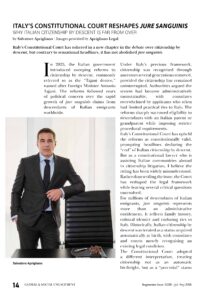
Segmento, the magazine of the Italian-speaking community abroad, published an article authored by Avv. Salvatore Aprigliano, founder of Aprigliano International Law Firm, on Italy’s Constitutional Court ruling and its consequences for Italian citizenship by descent. The article argues that, contrary to widespread headlines declaring the “end” of jure sanguinis, the Constitutional Court has reshaped, not abolished, the legal framework, leaving several critical questions open for ordinary courts and, potentially, the Court of Justice of the European Union. We break down exactly what the Tajani Decree changed and who it affects in The Tajani Decree Explained, the first episode of The Aprigliano Brief.
Did Italy’s Constitutional Court end Italian citizenship by descent?
In the immediate aftermath of the ruling, headlines across the Italian-speaking world declared a “tombstone on jure sanguinis” and a “final stop for descendants.” According to Avv. Aprigliano, writing in Segmento, this reading calls for careful correction.
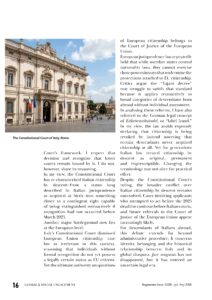
Italy’s Constitutional Court upheld the constitutional validity of the Tajani Decree within the scope of the specific questions examined, but it did not settle the broader conflict. The Court reshaped the legal framework while leaving several critical questions unresolved. For millions of descendants of Italian emigrants worldwide, this distinction matters enormously: jure sanguinis has not disappeared, but it has entered an uncertain and more technically demanding legal era.
Three legal dimensions that remain open
1.The reinterpretation of citizenship as a “potential” status, and why it matters
Historically, Italian citizenship by descent was treated as a status acquired automatically at birth, with consulates and courts merely recognising an existing legal condition. The Constitutional Court adopted a different interpretation: citizenship by descent is not an automatic birthright, but a “potential” status that only fully exists once formally recognised.
This distinction is, in Avv. Aprigliano’s view, the ruling’s true turning point. If citizenship exists at birth, retroactive restrictions could amount to stripping individuals of a status they already possess. If citizenship instead remains a contingent entitlement, Parliament arguably has greater authority to redefine eligibility rules before recognition is completed. Critics, including Avv. Aprigliano, argue this amounts to what German law calls Etikettenschwindel, or “label fraud”: by declaring that certain descendants never acquired citizenship at all, the law avoids expressly revoking a right that Italian jurisprudence had treated for generations as original, permanent and imprescriptible.
2. Applicants who tried to act before March 2025 but could not, and the Bologna precedent
One of the most consequential questions left open by the Constitutional Court concerns applicants who attempted to begin the citizenship process before the March 27, 2025 cutoff but were unable to secure consular appointments. For years, Italy’s Prenotàmi booking platform became synonymous with inaccessibility: calendars closed instantly, waiting periods stretched into years, and in some cases consulates communicated that appointments were already scheduled through 2029.
The Constitutional Court acknowledged the issue but left it unresolved, noting it fell outside the scope of the original challenge. That omission may prove decisive for thousands of applicants. In the cases handled by Aprigliano International Law Firm, the Tribunal of Bologna drew a clear distinction: in ruling no. 3335/2026 of April 17, 2026, the court accepted that a client had clearly demonstrated the intention to seek Italian citizenship despite being unable to secure a consular appointment. In May 2026, the same court recognised citizenship for two further clients, finding they had activated the recognition process before the cutoff through documented communications with consular offices. The principle emerging from Bologna is that demonstrated, documented intent, even without a formal appointment, may retain legal weight under the new framework.
For a full breakdown of this evidentiary standard, see our episode on Proof of Activation After the Tajani Decree, episode 3 of The Aprigliano Brief.
3. The European Union dimension, the final word has not been spoken
Italy’s Constitutional Court dismissed European Union citizenship case law as irrelevant on the grounds that individuals without formal recognition do not yet possess a legally certain status as EU citizens. Avv. Aprigliano challenges this reasoning: the ultimate authority on questions of European citizenship belongs to the Court of Justice of the European Union, not to national constitutional courts.
European jurisprudence has consistently held that while member states control nationality laws, they cannot exercise those powers in ways that undermine the protections attached to EU citizenship. The Tajani Decree, which applies retroactively to broad categories of descendants born abroad without individual assessment, may struggle to satisfy that standard. Future referrals to the Court of Justice of the EU appear increasingly likely, and this dimension remains, according to Avv. Aprigliano, the most significant open ground in post-reform litigation.

Avv. Aprigliano’s conclusion: a new chapter, not a closed book
Writing in Segmento, Avv. Aprigliano concludes that Italian citizenship by descent has not been abolished, but it has entered a more uncertain and more technical legal era. The Constitutional Court’s ruling has resolved one set of questions while opening others. For descendants of Italians abroad, the debate extends far beyond administrative procedure: it concerns identity, cultural belonging and the historical relationship between Italy and its global diaspora.
For Aprigliano International Law Firm, which has for years handled Italian jure sanguinis proceedings, including the landmark Bologna rulings of April and May 2026, the priority remains assessing each case individually: examining the specific circumstances, the documentation available, and the legal arguments that remain viable after the reform. Each case is different, and generalised conclusions drawn from any single ruling are rarely sufficient.
Subscribe to our newsletter!
Frequently Asked Questions: Italian citizenship by descent and the Segmento article
Did Italy’s Constitutional Court abolish Italian citizenship by descent?
No. The Constitutional Court upheld the Tajani Decree within the scope of the specific questions examined, but left several critical legal fronts unresolved. According to Avv. Aprigliano’s analysis in Segmento, jure sanguinis has not ended, it has entered a more complex and uncertain legal phase
What is the significance of the Constitutional Court’s reinterpretation of citizenship?
The Court treated citizenship by descent not as a status acquired at birth, but as a “potential” right that only fully exists once formally recognised. Avv. Aprigliano argues this reinterpretation , which he compares to the German concept of Etikettenschwindel, is the ruling’s true turning point, as it gives Parliament greater authority to restrict eligibility retroactively.
What happened in the Bologna cases mentioned in the Segmento article?
The Tribunal of Bologna issued two favorable rulings for clients of Aprigliano International Law Firm. Ruling no. 3335/2026 of April 17, 2026 recognized citizenship for a client who had demonstrated clear intent to apply despite being unable to secure a consular appointment. In May 2026, a further ruling recognized citizenship for two clients who had activated the process before the March 2025 cutoff through documented communications.
What about applicants who tried to book a consular appointment but could not?
The Constitutional Court acknowledged this issue but left it unresolved. The Bologna rulings suggest that documented, concrete steps toward recognition, even without a confirmed appointment, may retain legal weight. Each case must be assessed individually.
Is there still a path through EU law?
Yes. The Court of Justice of the European Union has the final word on questions of EU citizenship law, and future referrals appear increasingly likely. European jurisprudence requires that national citizenship laws not undermine EU citizenship protections, a standard the Tajani Decree may struggle to meet given its retroactive, categorical application.
What does Aprigliano International Law Firm do for citizenship applicants?
The firm has handled Italian jure sanguinis proceedings for years, including the Bologna rulings of April and May 2026. Its approach is to assess each applicant’s specific circumstances individually, identifying which legal path, pre-reform conduct, constitutional grounds, or EU law, remains viable for that particular case.
Request a Case Review
If you are a descendant of an Italian-born ancestor and want to understand which legal path remains open after the Constitutional Court’s ruling, a case-specific review is the necessary first step.